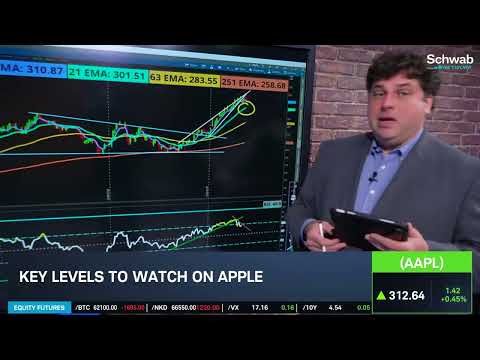
NASDAQ:AAPL

Apple Falls 3% Despite Generally Supportive Analyst Commentary

Apple (AAPL) shares fell nearly 3% even as Wall Street analysts largely maintained constructive views on the stock, suggesting investors were focused more on broader market concerns and near-term growth questions than on today's analyst updates.

Several major firms reiterated their existing ratings, while some became more optimistic about Apple's long-term prospects. Most notably, Morgan Stanley raised its price target to $360 from $330 while maintaining an Overweight rating, implying substantial upside from current levels. Maxim Group also increased its target to $350 from $310 while reiterating a Buy rating.

The overall tone of today's analyst commentary remained cautiously positive. Bullish firms continue to point to Apple's expanding services ecosystem, growing artificial intelligence opportunities, and the potential for future hardware upgrade cycles. However, some analysts maintained more neutral positions, reflecting concerns about slowing iPhone demand, competitive pressures in AI, and uncertainty surrounding consumer spending.

The market's reaction suggests investors are currently placing greater weight on execution risks and valuation concerns than on incremental target-price increases. After Apple's strong performance over the past year, expectations remain elevated, making it difficult for analyst reiterations alone to drive the stock higher.

For long-term investors, the key takeaway from today's reports is that many analysts continue to see meaningful upside potential despite near-term volatility, with several targets remaining well above the current share price.
Apple Outperforms Broader Market Selloff as Investors Remain Confident in Long-Term Outlook

Apple declined just 1.2% on Friday and gained an additional 0.1% in after-hours trading, significantly outperforming the broader technology sector during a session that saw the Nasdaq plunge more than 4%.

The relative strength suggests investors continue to view Apple as one of the safer large-cap technology holdings amid increasing market volatility. While high-growth semiconductor and AI-related stocks came under heavy pressure following stronger-than-expected U.S. employment data and rising Treasury yields, Apple's more defensive business model helped limit selling pressure.

Investor sentiment may also have been supported by continued optimism surrounding Apple's artificial intelligence strategy, upcoming product cycle, and massive cash generation capabilities. Unlike many AI-linked companies that trade at elevated growth valuations, Apple benefits from a large installed base of loyal customers, recurring services revenue, and one of the strongest balance sheets in corporate America.

A research note circulating in the market showed Wedbush analyst Dan Ives maintaining an Outperform rating on Apple with a $400 price target, implying substantial upside from current levels. Dan Ives has remained one of Wall Street's most bullish Apple analysts, frequently highlighting the company's AI opportunities, ecosystem strength, and potential for a multi-year upgrade cycle driven by AI-enabled devices.

The stock's ability to hold relatively steady while the Nasdaq suffered one of its sharpest declines in over a year may indicate that investors are rotating toward higher-quality technology companies as concerns grow about interest rates remaining elevated for longer. In an environment where speculative growth stocks face increasing pressure, Apple appears to be benefiting from its reputation as a technology leader with durable earnings, strong free cash flow, and resilient consumer demand.

While broader market volatility may continue in the near term, Friday's trading demonstrated that investors remain willing to own Apple even during periods of significant weakness across the technology sector.

Apple Manufacturing Academy accelerates AI use in U.S. supply chains - Apple

Apple’s Manufacturing Academy hosted its inaugural Spring Forum, bringing together U.S. manufacturers to accelerate the use of AI in supply chains.

(apple.com)
Apple Rises 3.4% in Pre-Market as Record iPhone and Services Quarter Overshadow Memory Cost Warning

Apple shares are up 3.4% in pre-market trading tody, after the
company delivered its best March quarter in history, topping estimates across every major category and issuing guidance that dramatically beat expectations.

Revenue came in at $111.2 billion, up 17% year-over-year, beating the $109.66 billion consensus, while EPS of $2.01 topped estimates of $1.95 and grew 22% from the prior year. iPhone revenue surged 22% to $57 billion, a March quarter record, with CEO Tim Cook citing extraordinary demand for the iPhone 17 lineup as the primary driver. (9to5Mac, heygotrade)

Services continued its relentless march higher. Services revenue grew 16.3% to $30.98 billion, setting a new all-time record and beating the $30.4 billion estimate, with double-digit growth in both developed and emerging markets and all-time records across every major category within the segment. Greater China was a standout, with revenue growing 28% to $20.49 billion against an $18.9 billion expectation, a number that will silence near-term concerns about China demand erosion. (Yahoo Finance)

The Q3 guidance was the real catalyst for after-hours and pre-market enthusiasm. Apple guided Q3 revenue growth of 14% to 17%, against analyst expectations of just 9.5% growth to $103 billion, a massive beat that pushed shares sharply higher during the conference call. (StockAnalysis)

There are two near-term headwinds worth watching. Cook warned that significantly higher memory costs are expected to impact gross margin in the June quarter and beyond, driven by the global AI data center build-out creating a memory component shortage. Supply constraints on Mac mini and Mac Studio are also expected to persist for several months. (heygotrade)

The earnings call also marked a significant leadership moment. Cook confirmed he will transition to executive chairman on September 1, with hardware SVP John Ternus becoming CEO, and Apple announced the end of its formal net cash neutrality target, authorizing a new $100 billion buyback and raising the quarterly dividend 4% to $0.27 per share. (heygotrade)

After the results were released, shares initially dipped as much as 1.24% before rebounding to a gain of 5.36%, ultimately settling around 1.86% by the end of after-hours trading, with pre-market extending the gains further as investors digested the blowout Q3 guidance.

Formula 1® returns to the U.S. this weekend, streaming live on Apple TV - Apple

Formula 1® returns to the U.S. this weekend with the Miami Grand Prix, streaming exclusively on Apple TV with every session available live.

(apple.com)
Apple announced significant progress in its environmental initiatives, reporting that 30% of materials used in products shipped in 2025 were recycled—its highest level to date. The company also achieved key sustainability milestones, including eliminating plastic from packaging and transitioning بالكامل to fiber-based alternatives, as well as using 100% recycled cobalt in its batteries and recycled rare earth elements in magnets.

As part of its broader “Apple 2030” strategy to achieve full carbon neutrality, the company said its greenhouse gas emissions remain over 60% below 2015 levels despite business growth. Apple also expanded renewable energy use across its supply chain, with suppliers generating more than 20 gigawatts of clean energy, while advancing water conservation efforts by replenishing over half of its corporate water usage.

The company highlighted innovations in recycling technology, including new systems to improve material recovery from old devices, and noted that its newly launched MacBook Neo features 60% recycled content, making it its lowest-carbon laptop to date. Apple added that it continues to scale zero-waste operations across facilities and suppliers, reinforcing its push toward a more sustainable product lifecycle.
Apple has expanded its American Manufacturing Program, adding new partners including Bosch, Cirrus Logic, TDK and Qnity Electronics to strengthen its U.S. supply chain.

The company plans to invest $400 million through 2030 as part of its broader $600 billion commitment to U.S. manufacturing and innovation, aiming to boost domestic production of critical components and advanced materials.

Key initiatives include producing sensors and semiconductor components in the U.S., developing new chip technologies with partners such as GlobalFoundries, and supporting advanced features like Face ID and device sensors.

The expansion also supports job creation and workforce development, with Apple continuing to invest in training programs such as its Manufacturing Academy, as the company deepens its focus on strengthening domestic manufacturing capabilities.
Apple launches all-in-one “Apple Business” platform for companies

March 24, 2026 — Apple announced the launch of Apple Business, a new integrated platform designed to help companies manage devices, streamline operations, and reach customers, with global availability starting April 14.

The platform combines mobile device management, business email, calendar, and collaboration tools into a single interface, allowing organizations to configure devices, manage employees, and deploy apps efficiently. It also supports custom domain-based communication and integrates with identity providers for automated account setup.

Apple Business introduces new marketing capabilities, including the ability for businesses in the U.S. and Canada to place ads in Apple Maps, enhancing local customer discovery while maintaining Apple’s privacy-focused approach.

The service will be offered free of charge in over 200 countries, with optional paid features such as expanded iCloud storage and AppleCare+ for Business. Apple said the platform is aimed at simplifying IT management, particularly for small and medium-sized businesses, while improving productivity and customer engagement.
Apple unveiled AirPods Max 2, an updated version of its premium over-ear headphones featuring the H2 chip, stronger active noise cancellation and a range of new intelligent audio features.

The company said the new model delivers up to 1.5 times more effective noise cancellation than the previous generation, along with improved sound quality, 24-bit/48 kHz lossless audio over USB-C, and new features including Adaptive Audio, Conversation Awareness, Voice Isolation and Live Translation. Apple also added tools aimed at creators, such as studio-quality audio recording and camera remote functionality.

AirPods Max 2 will be available to order starting March 25 in five colors — midnight, starlight, orange, purple and blue — with retail availability beginning early next month. The headphones will start at $549 in the United States.
Apple announced that “Friday Night Baseball” will return to Apple TV on March 27, marking the fifth season of the weekly MLB doubleheader streaming series. The program will feature two games every Friday throughout the 25-week 2026 MLB regular season, with the opening matchups being Los Angeles Angels vs. Houston Astros and Cleveland Guardians vs. Seattle Mariners.

Apple said the broadcasts will be available in more than 60 countries and will include enhanced production features, expert commentary teams, and no local blackout restrictions. The company also plans to further integrate iPhone cameras into the live broadcast workflow after previously using the iPhone 17 Pro during a 2025 MLB game, a milestone that was later recognized by the National Baseball Hall of Fame.

Subscribers can watch the games through the Apple TV app across multiple devices and platforms, while additional MLB-related programming and highlights will also be available within Apple’s broader sports ecosystem, including the Apple Sports app and Apple News.
Video Thumbnail
06-09-26Global Finance News
Video Thumbnail
06-06-26The Investor
Video Thumbnail
06-01-26WS News
Video Thumbnail
05-22-26European Investor
Video Thumbnail
05-22-26European Investor